
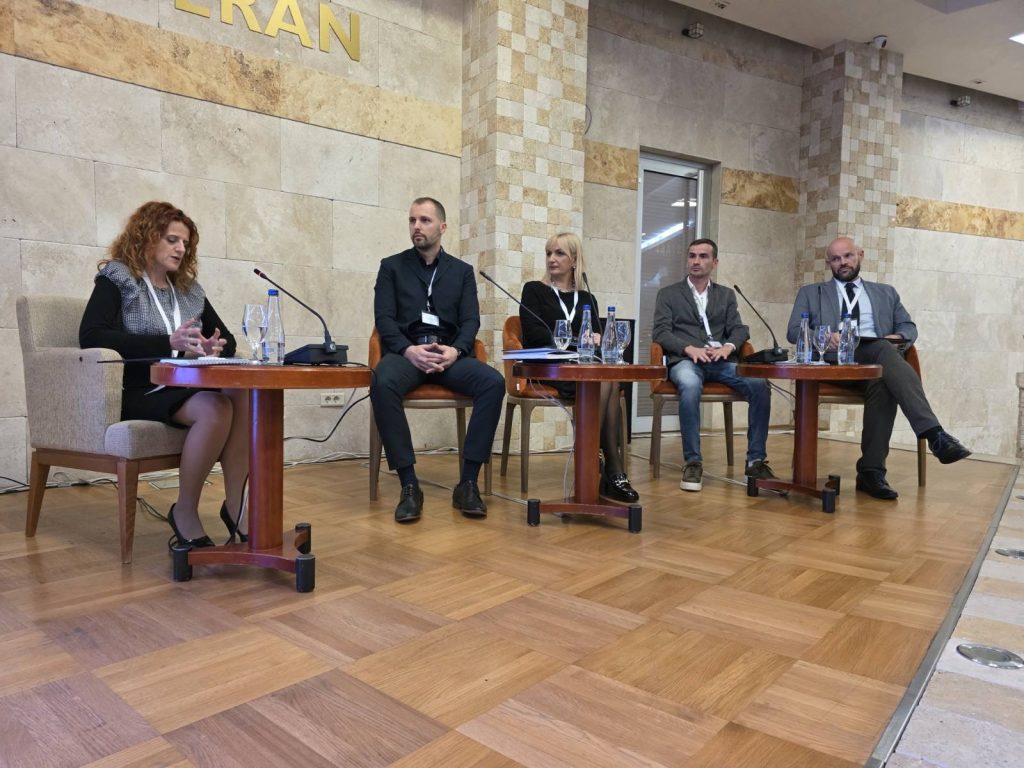
Montenegro has currently fulfilled only one-third of its obligations in the field of wastewater treatment systems. The biggest challenges include inadequate project and technical documentation, a shortage of qualified professionals, administrative barriers, and water losses in the supply network exceeding 50 per cent, while water consumption continues to rise, participants heard during the session "Projects in the Water Sector", held as part of the 6th International Water Conference, organised by the Union of Municipalities of Montenegro and the Water Supply and Sewerage Association of Montenegro, with the support of RCDN and in cooperation with numerous international partners.
The aim of the session was to highlight ways to improve the water services sector in Montenegro through concrete examples of completed, ongoing, and planned projects – from the planning and documentation preparation stages to implementation and ensuring the sustainability of the results achieved.
The session was moderated by Sanja Živković, the Secretary of the Committee for Public Utility Services and Environmental Protection of the Union of Municipalities of Montenegro, who highlighted the importance of exchanging experiences among public utility companies, providing support to local governments and state institutions, and applying successful models in different local communities.
Dragutin Sekulović representing PROCON, the national project implementation unit with more than 13 years of experience in managing infrastructure projects in the fields of public utility services and environmental protection, stressed that Montenegro has currently fulfilled only one-third of its obligations in negotiations with the European Union regarding wastewater treatment systems. “The most important thing is for citizens to understand that we are doing all of this for ourselves, while EU membership is merely the outcome. These systems are at the core of environmental protection and the quality of life of our citizens,” Sekulović said. He pointed to various challenges in project implementation, ranging from inadequate documentation and a shortage of qualified staff to administrative barriers. He particularly emphasised the need for better communication with citizens through their timely involvement and information about ongoing processes, adding that “thorough preparation leads to shorter and more successful implementation.”
Dr Jelena Borovinić Bojović representing the Union of Municipalities of Montenegro, she presented the comprehensive support that the Union provides to local self-governments. As she pointed out, this support includes the establishment of a Network of Project Managers to facilitate the exchange of knowledge and experience; advocacy for the creation of dedicated project units in all municipalities; the initiation of a revolving fund for the pre-financing of donor-funded projects, enabling municipalities with limited financial capacity to access funding; a training programme on preparing project applications, which has so far contributed to the development of projects worth more than EUR 11 million; and the establishment of a List of External Experts to support municipalities. Bearing in mind that no municipal project can be nominated for financing from the state capital budget or available international donor funds without prepared technical documentation, she particularly emphasised the importance of the Union of Municipalities’ Solidarity Fund for the Preparation of Technical Documentation, intended for municipalities benefiting from the Equalisation Fund. To date, more than EUR 660,000 has been allocated through this mechanism, with an additional EUR 450,000 planned by the end of this year.
Continuing the discussion, Dr Borovinić Bojović pointed out that water supply and sewerage systems are highly complex and require a multidisciplinary approach. She emphasised the importance of the proactive engagement of local self-governments, with the invaluable support of implementation units such as PROCON and VODACOM, and announced the continuation of capacity-building programmes through the RCDN+ project, which is focused on investment management in the field of wastewater treatment.
Dragan Papić, the director of Komunalno i Vodovod Žabljak presented the experience of this small municipality as an example of successfully addressing the challenges of limited resources and specific geographical conditions, showcasing concrete projects that can serve as a model for other local communities. In just two years, the municipality and its public utility company managed to secure support for investments in communal infrastructure worth more than EUR 11 million. At the same time, they prepared project applications for additional grant funding amounting to EUR 36 million, while also completing the necessary technical documentation for all of these initiatives. He expressed particular gratitude to the Union of Municipalities of Montenegro, noting that its Solidarity Fund had helped finance the preparation of part of the required technical documentation.
Milan Janović representing the Regional Water Supply Company of Montenegro, he pointed out that the company ensures a reliable water supply even in hydrologically challenging years. Investments made by the company to maintain a stable water supply amount to several tens of millions of euros; however, as he stressed, all these efforts will be insufficient unless the high levels of water losses within the system are addressed. By August 2025, the Regional Water Supply Company had delivered 8.1 million cubic metres of water, equivalent to approximately 800 litres per second, while in August alone that figure reached as much as 1,000 litres per second. Rising water consumption, coupled with the declining yield of water sources, represents a challenge that the Regional Water Supply Company has successfully managed through the development of new intake facilities, while preserving the A1 quality standard of drinking water.
The participants of the session agreed that the sustainable development of Montenegro’s water sector depends not only on investments, but also on the continuous enhancement of knowledge, the strengthening of local capacities, and the strategic partnership of all relevant stakeholders – from public utility companies and municipalities to state institutions, as well as international partners and financiers.


