
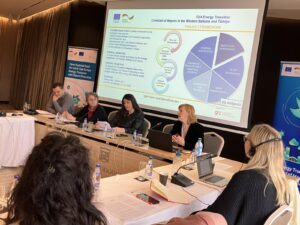
 Cooperation between the central and local levels in the field of sustainable energy and climate was the main topic of the “Multi-Level Governance” workshop organized by the Union of Municipalities of Montenegro and the German development agency GIZ. The workshop is part of the activities under the project EU4 Energy Transition: Covenant of Mayors in the Western Balkans and Türkiye, jointly co-financed by the European Union and the German Federal Ministry for Economic Cooperation and Development (BMZ), and implemented by GIZ in the Western Balkans and CPMA in Türkiye.
“The project addresses climate change and supports the energy transition in the Western Balkans and Türkiye by increasing the number of members of the Covenant of Mayors for Climate and Energy in the region and supporting local governments in turning their ambitions to reduce greenhouse gas emissions into reality and improving their resilience to the impacts of climate change, while taking local diversity into account. Through the project, municipalities participate in a multi-level governance dialogue on the development and implementation of energy and climate policy. The multi-level governance approach and integrated policy planning processes will facilitate improved and more realistic planning, as well as more effective policy implementation processes in the Western Balkan countries,” she said Jasna Sekulović, GIZ Project Coordinator for Montenegro. Sekulović highlighted that 19 Sustainable Energy and Climate Action Plans (SECAPs) had been prepared within the project, 12 of which have been adopted to date. In each of the countries participating in the project, one pilot project in this field has been successfully implemented.
“One of the project’s objectives is to strengthen the capacities of local government officials in this field. During its implementation, officials from selected municipalities had the opportunity to participate in various conferences across the region and in the Republic of Türkiye, with the aim of acquiring knowledge and exchanging experiences, as well as in workshops on sustainable energy and climate and multi-level governance, organized by GIZ in cooperation with the Union of Municipalities of Montenegro over the past few years,” Sekulović emphasized.
Marija Kljajić, project coordinator on behalf of the Union of Municipalities of Montenegro, highlighted that
over the past few years, thanks to the activities of the “EU4ET” project implemented jointly with the German development agency GIZ, cooperation between the Union of Municipalities and the relevant ministries in this field has improved.
“As regards the legislative framework, I would like to point out that the Law on Local Self-Government clearly stipulates the obligation of central government authorities to involve representatives of local self-governments, i.e. the Union of Municipalities, in the preparation of laws and other acts regulating the rights and obligations of local self-governments. The same Law also stipulates the obligation to submit draft laws and other acts to local self-government units, i.e. the association of municipalities, for their opinion, within a period of no less than 15 days,” Kljajić emphasized.
She recalled that, through its work and activities, the Union strives to maintain regular and open communication with the central authorities, positioning itself as a professional and equal partner in the development of public policies, with the aim of addressing challenges faced by local authorities and establishing smooth and continuous cooperation with the central level.
“The exchange of ideas and information between local and central authorities should aim to foster better understanding, build relationships based on trust, and ensure mutual professional, technical, financial and other forms of support in the common interest. Partnership in planning and decision-making is essential for accelerating the development of municipalities and, consequently, the country as a whole. It enables the rational and constructive use of all available resources with a view to creating a supportive legal and broader framework for transforming the state and municipalities into efficient public services for citizens,” Kljajić highlighted.
According to her, cooperation, joint commitment and coordinated efforts are prerequisites for the effective functioning and development of local self-government and, consequently, of the country as a whole, which should ultimately serve citizens efficiently.
Participants also had the opportunity to learn about the experiences of NetZeroCities, an organization comprising 33 partners from 27 European countries that manages the EU Cities Mission platform. The project supports 112 European cities, known as Mission Cities, in drastically reducing greenhouse gas emissions in order to achieve climate neutrality. The EU Cities Mission supports the European Green Deal in building a low-carbon, climate-resilient future through research and innovation.


