
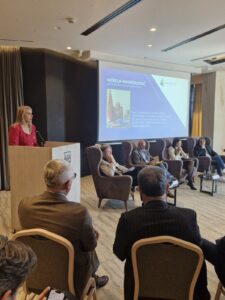
 “At the Ministry of Public Administration, we have placed the reform of the local self-government system high on our list of priorities, with particular emphasis on decentralisation and digitalisation. In this context, the Government of Montenegro adopted in 2024 the Analysis of the Functioning of the Local Self-Government System, which revealed numerous weaknesses in the existing system and highlighted the urgent need for change,” said the Minister of Public Administration. Marash Dukaj in the introductory part of the panel discussion “Electoral Legislation Reform: A Single Election Day, Direct Election of Municipal Presidents/Mayors and Open Lists – Challenges and Advantages”, organised by the Union of Municipalities of Montenegro.
Minister Dukaj emphasised that strong and efficient local self-government is the foundation of a strong and fair society. According to him, the Analysis showed that Montenegro is one of the most centralised countries in Europe, that the monotypic model of local self-government organisation is unsustainable, and that there are serious challenges regarding local public finances and the functioning of municipally owned companies. He also noted that the current method of electing mayors and municipal presidents is inadequate, as it does not reflect electoral legitimacy.
“The relationship between central and local authorities must be improved. We have addressed all these issues through the new Law on Local Self-Government. However, it is clear that we cannot achieve substantive change without a comprehensive reform of the electoral system. That is why, back in May last year, we submitted two key initiatives to the Parliament of Montenegro:the introduction of direct elections for municipal presidents and holding all local elections on the same day” istakao je Dukaj i dodao „I am convinced that these initiatives strengthen the democratic nature of the electoral process and reduce political tensions. Consequently, they directly contribute to the success of the reform processes that we have thoroughly and systematically initiated.”
“I am convinced that only through systemic reform, bold decisions and open dialogue can we builda modern, efficient and accountable local self-government. Our goal is clear – to empower local communities in which government will be brought closer to citizens, and local institutions will work in their best interests,” said Dukaj.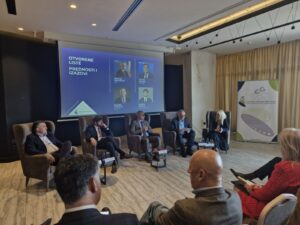
The Secretary General of the Union of Municipalities of Montenegro Mišela Manojlović, who opened the panel together with Minister Dukaj, emphasised that the issue of local elections primarily concerns citizens.
“As voters, they want a functional local self-government capable of providing the conditions for a good quality of life in local communities. Elections are the instrument that gives them the opportunity to achieve such conditions,” Manojlović emphasised.
In her introductory remarks, Manojlović recalled that, during Montenegro’s multiparty democracy, there was a brief period when municipal presidents were directly elected. “Some of us witnessed that period, as well as the occasions when elections for local assemblies were held on the same day. That is why it is very important today to recall the reasons why direct elections were introduced by a special law in 2003, to answer the question of why we abandoned them six years later, and to consider whether holding elections for local assemblies on the same day actually resolved anything in a substantive and lasting way. Is now the right time to revive these practices, or should we consider other options tailored to our very specific social and political context? More precisely, should we address the causes of dysfunction in certain municipalities, or merely remedy the consequences in a way that we applied not so long ago and have already seen where it leads?” Manojlović emphasised.
Secretary General of the Union of Municipalities Manojlović emphasised that, given the credentials and experience of the panellists, participants expected the panel to provide them with a better understanding of which types of electoral systems around the world offer voters the strongest guarantees that government will function effectively, what their advantages and disadvantages are, and whether, in the panellists’ view, such systems could be applied in Montenegrin municipalities. What exactly do open, semi-open or preferential lists mean, and how would they affect local elections in Montenegro? Could an overly open system lead to chaos in governance? And most importantly, how can the electoral process be adapted to the specific needs of the community in a way that strikes a balance between representativeness and accountability?
“These are issues that have a fundamental impact on citizens’ constitutionally guaranteed right to local self-government, which in recent years has increasingly and ever more clearly shown its vulnerability. Of course, something needs to change, but not without first identifying the problem and conducting a thorough and expert analysis of it. We will consider our joint efforts successful if we make the cause-and-effect relationship between different proposals for amending electoral legislation and their consequences clear, and if we can agree today on a model that will enable the efficient functioning of local self-governments in Montenegro,” Manojlović concluded.
The first panel was held on the topic of “Advantages/challenges of the direct election of municipal presidents/mayors and holding elections on the same day” which brought together distinguished panellists Nina Blažić, the Ministry of Public Administration, Dragan Koprivica, the Centre for Democratic Transition, Đorđije Blažić, the Faculty of State and European Studies, and Dragan Šoć, a lawyer.
The second panel, entitled “Open Lists – Advantages / Challenges”, brought together experts in this field, Dragišu Janjuševića from the Ministry of Public Administration, Mladena Vukčevića, Faculty of Legal Studies, UDG, Zlatka Vujovića, Faculty of Political Science, UCG, and Vasilija Čarapia from the Parliament of Montenegro’s Committee on Comprehensive Electoral Reform.
The panels, which prompted open discussions, brought together municipal presidents and presidents of municipal assemblies, as well as representatives of local self-government units.


